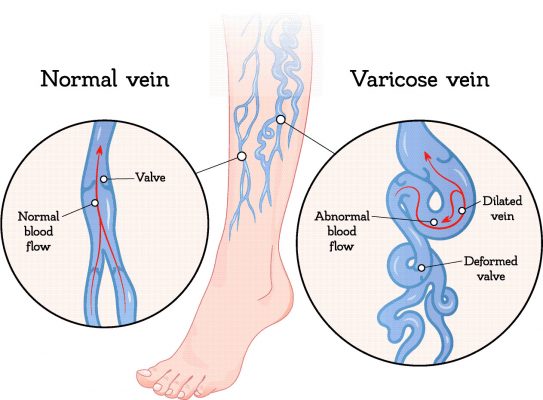


Varicose veins are caused by faulty valves in leg veins that prevent blood from flowing back to the heart normally. Not only do varicose veins look bad on one’s legs, the patient’s legs also get tired and cramped easily, and in some cases there might also be darkened skin festering sore.
Conventionally varicose veins are dealt with by open surgery in which the patient undergoes general anaesthesia and is hospitalised for usually around a week. However, treating varicose veins with minimally invasive surgery requires only local anaesthesia during operation and can be performed in a small operating theatre in a clinic. In a locally anaesthetised condition, the doctor puts a laser or radiofrequency catheter into the great saphenous vein whose valves are malfunctioning, and closes this vein where a venous reflux is occurring. After the operation, blood will be able to flow back to the heart normally, and problems such as swollen legs will be alleviated, and so will issues like bad appearance.
This treatment takes only 30 to 45 minutes, and avoids the risks of general anaesthesia. Although the surgical fee is higher than traditional open surgery, the overall cost is usually lower because of a shorter occupancy duration of operating theatre and the absence of inpatient charges. Moreover, the patient can also return to work sooner.
The five-year recurrence rate for patients treated this way is only 6%, as compared to 30-40% for conventional open surgery. The procedure is maturely developed, having 18 years of history in Hong Kong, and has attained the gold standard of minimally invasive surgery.